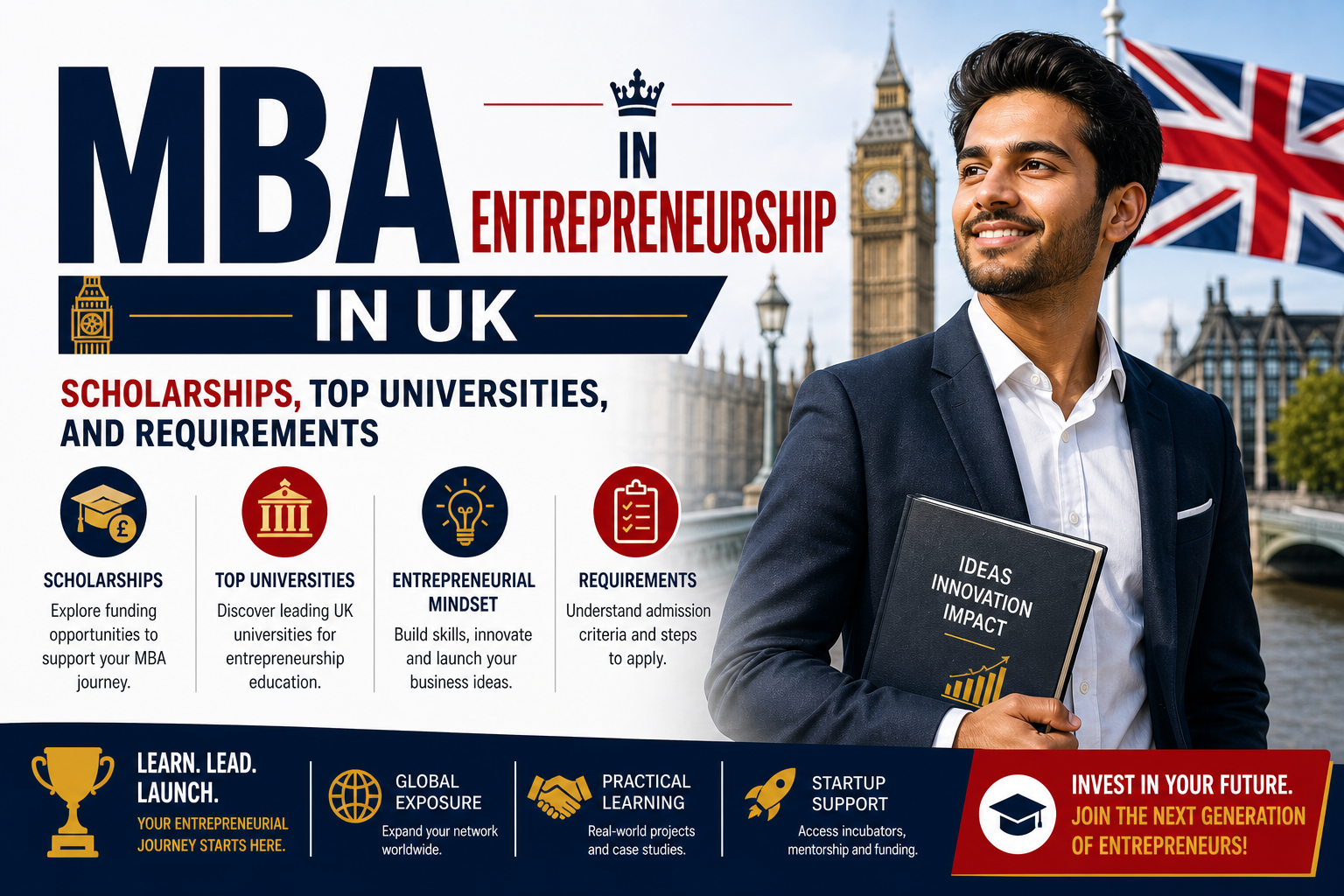
Pursuing an MBA in Entrepreneurship in the UK is one of the most strategic educational decisions aspiring founders, startup leaders, and innovation-driven professionals can make. The United Kingdom has earned a global reputation for producing successful entrepreneurs, housing world-class business schools, and creating environments where startups can thrive. For individuals looking beyond traditional employment paths and seeking opportunities to build scalable ventures, the UK offers a unique combination of education, networking, and access to global markets.
In recent years, entrepreneurship has experienced a major transformation. More professionals are moving away from conventional corporate careers and seeking greater independence through business ownership, startup creation, and innovation-led careers. The growing influence of technology, digital businesses, remote work, and global investment opportunities has created a demand for entrepreneurial leaders capable of navigating rapidly changing markets.
As a result, MBA programs focused specifically on entrepreneurship have become increasingly popular. Unlike a traditional MBA that primarily emphasizes corporate management and executive leadership, an MBA in Entrepreneurship focuses on building practical startup skills, understanding venture creation, securing funding, identifying opportunities, and managing business growth.
Students enrolled in entrepreneurship-focused MBA programs learn how to transform ideas into viable businesses while gaining exposure to real-world entrepreneurial challenges. Through startup incubators, mentorship opportunities, networking events, consulting projects, and investor partnerships, students receive hands-on experience beyond classroom theory.
For many international students, one major reason for choosing the UK is its thriving startup ecosystem. London remains one of the leading startup cities globally and attracts billions in venture capital investments annually. Cities such as Oxford, Cambridge, Manchester, and Edinburgh also continue to develop strong innovation communities that connect students with entrepreneurs, investors, researchers, and business leaders.
Another attractive feature is the structure of UK MBA programs. While countries such as the United States frequently offer two-year MBA programs, many universities in the UK provide intensive one-year programs. This shorter structure allows students to reduce educational costs while returning to the workforce sooner.
However, despite these advantages, obtaining an MBA in Entrepreneurship in the UK requires careful planning. Tuition fees at highly ranked business schools can range from £30,000 to over £95,000, depending on the institution and program structure.
When accommodation, transportation, visa fees, health insurance, educational materials, and living expenses are included, the total cost can increase substantially.
Estimated annual costs typically include:
Top-tier schools: £50,000–£80,000 per year
Mid-tier institutions: £35,000–£55,000 per year
Total degree investment: £100,000–£150,000+
For many students, these costs make scholarships and financial aid opportunities extremely important.
Fortunately, the UK offers numerous scholarship programs designed specifically for international students and MBA candidates. Government-funded initiatives, university awards, merit scholarships, and entrepreneurship grants help reduce financial pressure significantly.
This guide explores everything prospective students need to know about pursuing an MBA in Entrepreneurship in the UK in 2026.
Topics covered include:
- Understanding what an MBA in Entrepreneurship actually offers
- Leading UK universities and business schools
- Admission requirements and eligibility criteria
- Tuition fees and cost breakdowns
- Scholarship opportunities and funding sources
- Student visa processes
- Career opportunities and salary expectations
- Application strategies for improving admission chances
Whether your goal is launching a technology startup, leading a family business, building a social enterprise, or entering venture capital, understanding the process early can dramatically increase your chances of success.
An MBA in Entrepreneurship in the UK is more than an academic qualification. It can become a platform for accessing investors, developing leadership skills, building international networks, and creating long-term business opportunities.
What Is an MBA in Entrepreneurship in UK?
An MBA in Entrepreneurship in the UK is a specialized graduate business degree designed for students who want to start businesses, lead innovative organizations, or build entrepreneurial careers.
Traditional MBA programs generally focus on preparing students for executive roles in large corporations. Coursework usually revolves around management structures, operational efficiency, finance, and organizational leadership.
Entrepreneurship-focused MBA programs take a different approach.
These programs are designed around the realities of building businesses from the ground up.
Students learn not only how businesses operate but also how businesses are created.
Course structures commonly include:
- Startup creation and development
- Entrepreneurial leadership
- Venture capital and startup financing
- Innovation management
- Product development
- Business model design
- Market opportunity analysis
- Scaling and growth strategies
- Strategic leadership
Students often work on practical projects involving startup development, pitch competitions, business simulations, and consulting activities.
Many UK business schools integrate real startup ecosystems directly into their MBA programs.
Students may receive opportunities to:
- Develop business ideas with mentors
- Access startup incubators
- Meet investors and founders
- Participate in venture competitions
- Join entrepreneurship clubs
- Build relationships with successful alumni entrepreneurs
Unlike purely theoretical programs, entrepreneurship MBAs place strong emphasis on practical execution.
Many graduates complete programs with functioning businesses, startup prototypes, investor relationships, and real-world business experience.
Structure of MBA in Entrepreneurship Programs
Although program structures differ among universities, most MBA in Entrepreneurship programs in the UK follow a relatively similar format.
Core Business Modules (First Phase)
Duration: approximately 6–9 months
Core subjects commonly include:
- Accounting and finance
- Marketing strategy
- Organizational behavior
- Operations management
- Economics
- Business analytics
- Leadership development
- Corporate strategy
These modules establish a strong business foundation before specialization begins.
Entrepreneurship Specialization
Duration: approximately 3–6 months
Entrepreneurship-focused modules often include:
- Venture financing
- Entrepreneurial strategy
- Startup scaling
- Innovation management
- Digital entrepreneurship
- Business design thinking
Students begin applying concepts directly to startup scenarios.
Capstone Project or Venture Development
Many universities require a final practical project.
Examples include:
- Startup launch projects
- Consulting assignments
- Venture business plans
- Market feasibility studies
- Investment pitches
Students may graduate with an operational business concept or startup strategy.
Program duration usually falls between:
Full-time MBA: 12–15 months
Part-time MBA: 24–36 months
Executive MBA: 18–24 months
Why Study MBA in Entrepreneurship in UK?
Students often compare the UK with destinations like the United States, Canada, Australia, and Europe.
The UK offers several advantages.
1. Global Reputation
British universities consistently rank among the world’s strongest institutions.
Employers worldwide recognize UK MBA qualifications.
Strong rankings create credibility with investors and employers.
2. Powerful Startup Ecosystems
London remains among the world’s most active startup hubs.
Entrepreneurship students gain access to:
- startup communities
- venture capital firms
- networking events
- founder groups
- accelerator programs
Access to entrepreneurial environments creates opportunities difficult to replicate elsewhere.
3. Shorter Programs
Many UK MBA programs last only one year.
Benefits include:
- Lower living costs
- Reduced tuition expenses
- Faster graduation
- Earlier career progression
Students save both time and money.
4. Graduate Route Visa Benefits
International students can remain in the UK after graduation for up to two years.
This allows graduates to:
- seek employment
- gain experience
- launch startups
- build networks
This flexibility attracts many international applicants.
5. Global Alumni Networks
Top UK business schools maintain extensive alumni communities.
Graduates often gain access to:
- investors
- recruiters
- startup founders
- mentors
- global executives
Networking frequently becomes one of the most valuable aspects of an MBA experience.
Top Universities and Admission Requirements
Selecting the right institution can significantly influence your MBA experience, future network, career opportunities, and entrepreneurial journey. While curriculum matters, entrepreneurship education extends beyond classroom lectures. The strongest programs create environments where students interact with investors, founders, startup accelerators, and innovation communities.
When evaluating an MBA in Entrepreneurship in the UK, students should consider factors beyond rankings alone:
- Strength of entrepreneurship specialization
- Startup incubators and accelerators
- Alumni founder networks
- Access to venture capital ecosystems
- Scholarship opportunities
- Industry partnerships
- Geographic location
- Program flexibility
- Employment outcomes
A student planning to launch a technology startup may prioritize universities with strong tech ecosystems, while someone interested in social entrepreneurship may prefer institutions with sustainability and impact-focused programs.
Below are some of the leading universities for entrepreneurship-focused MBA programs in the UK.
Top UK Universities for MBA in Entrepreneurship
1. London Business School
Often ranked among the world’s best business schools, London Business School (LBS) has built a reputation for producing founders, investors, and global business leaders.
Its MBA program offers strong entrepreneurship pathways and extensive networking opportunities.
Key advantages include:
- Entrepreneurship Summer School
- Startup incubators
- Venture capital connections
- Access to London startup ecosystems
- Entrepreneurship Club activities
- Investor pitch events
- Global alumni network
Students benefit from proximity to one of Europe’s largest financial and startup centers.
Approximate tuition:
£95,000
Program duration:
15–21 months
Best suited for:
Students seeking strong investor networks and global business exposure.
2. Saïd Business School
Oxford combines academic prestige with strong entrepreneurial support.
Its entrepreneurship ecosystem centers around innovation, impact, and scalable business development.
Notable features include:
- Startup mentoring
- Entrepreneur workshops
- Innovation labs
- Social entrepreneurship support
- Access to startup communities
- Founder networking opportunities
One major attraction is startup support through Oxford’s entrepreneurial ecosystem.
Approximate tuition:
£72,000
Program duration:
12 months
Best for:
Students interested in impact-driven ventures and innovation leadership.
3. Cambridge Judge Business School
Cambridge has developed one of Europe’s strongest technology ecosystems.
The university sits within an innovation cluster often called “Silicon Fen,” known for startup creation and technological research.
Advantages include:
- Startup competitions
- Technology commercialization support
- Entrepreneur mentorship
- Investor networking
- Innovation communities
- Strong STEM ecosystem
Approximate tuition:
£67,000
Duration:
12 months
Best for:
Technology entrepreneurs and innovation-focused students.
4. Imperial College Business School
Imperial has become especially known for entrepreneurship connected to science and technology.
Students gain exposure to:
- fintech ecosystems
- technology commercialization
- innovation labs
- startup development initiatives
- investor communities
Approximate tuition:
£60,000
Duration:
12 months
Best for:
Technology founders and digital entrepreneurs.
5. Warwick Business School
Warwick offers flexibility and strong business-industry connections.
Key strengths:
- entrepreneurship specialization
- hybrid learning options
- consulting opportunities
- leadership development
- startup-focused learning
Approximate tuition:
£47,000
Duration:
12 months
Best for:
Students seeking flexibility and strong industry relationships.
6. Alliance Manchester Business School
Manchester emphasizes practical learning and business application.
Program highlights include:
- sustainability initiatives
- entrepreneurship support
- startup consulting projects
- innovation-focused learning
Approximate tuition:
£50,000
Duration:
18 months
Best for:
Students interested in innovation and sustainability.
7. Cranfield School of Management
Cranfield focuses heavily on practical business application.
Students receive access to:
- consulting projects
- venture development support
- startup mentorship
- entrepreneurial workshops
Approximate tuition:
£42,000
Duration:
12 months
8. University of Edinburgh Business School
Edinburgh has built a growing entrepreneurial ecosystem with startup support and innovation partnerships.
Advantages include:
- entrepreneurship communities
- startup partnerships
- government-backed innovation support
- scholarship opportunities
Approximate tuition:
£35,000
Duration:
12 months
University Comparison Table
| University | Duration | Tuition | Major Strength |
|---|---|---|---|
| London Business School | 15–21 months | £95,000 | Global investor network |
| Oxford Saïd | 12 months | £72,000 | Social entrepreneurship |
| Cambridge Judge | 12 months | £67,000 | Technology ecosystem |
| Imperial College | 12 months | £60,000 | Deep tech and innovation |
| Warwick | 12 months | £47,000 | Flexible structure |
| Manchester | 18 months | £50,000 | Sustainability focus |
| Cranfield | 12 months | £42,000 | Practical entrepreneurship |
| Edinburgh | 12 months | £35,000 | Lower tuition options |
Remember: the “best” school depends on your career goals, financial situation, and preferred entrepreneurial focus.
Admission Requirements for MBA in Entrepreneurship in UK
Admission into UK MBA programs can be highly competitive.
Business schools evaluate applications holistically. High test scores matter, but schools also want evidence of leadership, initiative, entrepreneurial thinking, and professional impact.
Typical requirements include:
- Undergraduate degree
- Professional work experience
- GMAT or GRE scores (where required)
- English proficiency tests
- Recommendation letters
- Personal essays
- Resume/CV
- Interview performance
Let’s examine each area.
1. Bachelor’s Degree Requirement
Applicants must hold an undergraduate degree from a recognized institution.
Accepted academic backgrounds often include:
- Business
- Engineering
- Economics
- Finance
- Sciences
- Technology
- Social sciences
Most universities do not require business degrees.
Students from diverse backgrounds frequently succeed in entrepreneurship programs.
Strong academic performance strengthens applications.
Competitive applicants often demonstrate:
- solid GPA performance
- leadership activities
- projects
- business involvement
2. Work Experience Requirements
Unlike many master’s degrees, MBA programs generally expect applicants to possess professional experience.
Average expectations:
| School Type | Minimum Experience | Average Admitted Experience |
|---|---|---|
| Top-tier schools | 3 years | 5–7 years |
| Mid-level programs | 2 years | 3–5 years |
| Executive MBA | 8+ years | 10–15 years |
Work experience does not need to come from large corporations.
Business schools value:
- startup experience
- leadership positions
- entrepreneurial projects
- family business involvement
- consulting work
- management roles
Quality often matters more than company prestige.
3. GMAT or GRE Scores
Many MBA programs request standardized testing.
Competitive GMAT ranges:
680–730+
Competitive GRE ranges:
320+
However, admissions policies have changed in recent years.
Many universities now offer waivers for applicants who demonstrate:
- strong academic backgrounds
- quantitative work experience
- management achievements
- entrepreneurial success
Applicants should verify requirements directly with each institution.
4. English Language Requirements
International students whose first language is not English often must provide proof of proficiency.
Common score expectations:
| Exam | Competitive Score |
|---|---|
| IELTS | 7.0–7.5 |
| TOEFL | 100+ |
| PTE | varies |
Waivers sometimes exist for applicants educated in English-speaking environments.
5. Recommendation Letters
Most MBA applications request:
2–3 recommendation letters
Strong recommenders include:
- supervisors
- senior colleagues
- startup founders
- mentors
- professors
Recommendations should discuss:
- leadership ability
- initiative
- growth potential
- problem-solving skills
- communication ability
Generic recommendation letters weaken applications.
6. Personal Essays
MBA essays are often among the most important parts of the application.
Admissions committees want to understand:
- Why entrepreneurship?
- Why now?
- Why this school?
- What are your goals?
- What impact do you want to create?
Strong essays include measurable achievements and clear direction.
Example:
Weak:
“I want to become successful.”
Stronger:
“I aim to build a fintech platform improving financial access for underserved communities across Africa.”
Specificity creates stronger applications.
7. MBA Interviews
Applicants shortlisted by universities often receive interview invitations.
Formats may include:
- virtual interviews
- alumni interviews
- admissions panel interviews
- campus interviews
Interview questions commonly cover:
- leadership experiences
- failures and lessons learned
- startup ideas
- career goals
- teamwork situations
Preparation is essential.
Schools evaluate:
- communication skills
- confidence
- self-awareness
- entrepreneurial mindset